Regulatory compliance is a continuous operational discipline, not a checkbox. We build and manage programs for HIPAA, GLBA, and the FTC Safeguards Rule. Our work runs from initial gap analysis through ongoing evidence management and audit support.
Our compliance practice is built on the understanding that auditors want evidence, not promises. We do the technical work, write the documentation, and maintain the evidence library. The result is a compliance program that can survive scrutiny.
Security rules can feel complex because each framework uses different terms. The practical work is easier to understand: know your risks, protect important data, control access, train people, and keep proof.
We help your team decide which rules apply and what to do next. The work is based on your business, systems, contracts, and customer needs.
We support HIPAA, GLBA, and FTC Safeguards programs. The exact scope depends on the rule and your role under it.
We do not promise a certification that only an outside assessor can grant. We prepare the controls, documents, and evidence so your team is ready for review.
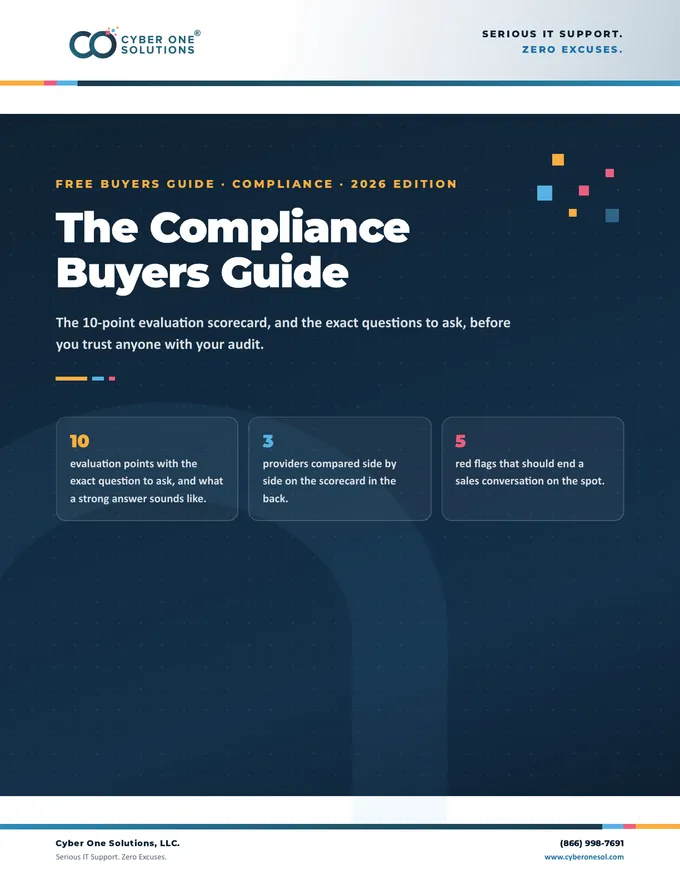
A plain-language guide to choosing a partner that can assess, implement, document, monitor, and prove security controls, not merely sell a policy binder before an audit. Cyber One Solutions supports HIPAA, GLBA, the FTC Safeguards Rule, and cyber-insurance readiness; the questions apply to any provider you evaluate.
We build compliance programs for the frameworks that matter most to Texas and Tennessee businesses. Click any framework card for detailed requirements, penalties, enforcement information, and links to official guidelines.
From the first gap analysis through annual audit support, we handle every part of your compliance program. Our team writes the policies, implements the controls, collects the evidence, and prepares your organization for scrutiny.
We assess your current posture against the target framework. You receive a written gap analysis with a prioritized remediation roadmap and estimated effort.
We write and deliver a complete set of information security policies, procedures, and standards. Each one is tailored to your organization and the frameworks you must satisfy.
We configure and deploy the technical controls required by your compliance framework. This work ranges from access management and MFA to encryption, logging, and endpoint security.
We build and maintain the evidence library your auditors will require. It includes screenshots, configuration exports, logs, and signed attestations.
Compliance is not a one-time project. We provide continuous compliance monitoring and management. Your program stays current as your environment and the standards evolve.
We prepare your team for audits and serve as your technical point of contact during auditor interviews. We also help respond to findings or requests for additional evidence.
Each compliance framework targets a specific industry and data type. Most businesses are subject to more than one. Below is a concise reference for each framework we support, who it applies to, and what our program covers.
Applies to: Healthcare providers, health insurers, clearinghouses, and business associates handling protected health information (PHI).
Our HIPAA compliance programs cover the Security Rule's administrative, physical, and technical safeguard requirements.
These include a Security Risk Analysis kept current as your environment changes (we refresh it at least annually), workforce training, Business Associate Agreements, and Breach Notification Rule compliance.
We build the documentation your auditors require and maintain it as your environment changes.
Applies to: Non-bank financial institutions regulated by the FTC, including auto dealerships, tax preparers, mortgage brokers, payday lenders, title companies, and accounting firms.
Banks and credit unions follow their banking regulators' GLBA safeguards standards, not the FTC rule.
The FTC Safeguards Rule as amended (compliance date June 9, 2023) requires a Written Information Security Program (WISP) and a designated Qualified Individual.
It also requires MFA for all systems with customer financial information, encryption of data in transit and at rest, ongoing testing of key controls, and an annual board report.
The rule permits continuous monitoring as an alternative to annual penetration testing. The specific path depends on your program design. We implement every required element and maintain your program on an ongoing basis.
Answers to common questions from organizations navigating regulatory requirements for the first time or preparing for an upcoming audit.
Both are required, but documentation without implementation is a liability. Auditors and regulators look for evidence that controls are actually in place and operating effectively, not just written policies. We build compliance programs where the technical controls are implemented first. We then document them to reflect what is actually running in your environment.
Timeline depends on your current posture and the applicable requirements. For organizations starting from scratch, initial compliance programs typically take 60 to 120 days to establish. We scope every engagement realistically based on what is actually needed.
We help you respond to findings and remediate gaps. For regulatory findings, we develop a corrective action plan with specific remediation steps, timelines, and evidence requirements. Our ongoing compliance management programs are designed to prevent findings. We keep your controls current and your evidence library complete before auditors arrive.
Yes. Audit preparation is one of our core services. We conduct readiness assessments and identify gaps that auditors are likely to flag. We then remediate critical issues, prepare your team for auditor interviews, and serve as your technical point of contact during the assessment process.
Yes. We can coordinate HIPAA, GLBA, and FTC Safeguards requirements when more than one applies. Many controls satisfy requirements across these programs at once, reducing duplicated work and keeping the evidence consistent.
Security is the actual protection of your systems and data. Compliance is proving to a regulator, auditor, customer, or insurer that your protection meets a defined standard. They overlap heavily but are not the same. If controls exist only in documents, you can be compliant on paper yet insecure in practice. You can also be reasonably secure yet fail an audit for lack of evidence. We build programs where the technical controls are implemented and operated first, then documented to reflect what is actually running. That way security and the evidence that proves it advance together, not as separate exercises.
We do both, and implementation is the core of what we do. Many consultants deliver a gap assessment and a stack of policy templates. They then leave the actual work of deploying and running controls to you. Cyber One Solutions implements and operates the technical controls a framework requires. That includes access control and multi-factor authentication, endpoint detection and response, centralized logging and monitoring, encryption, patch and vulnerability management, and incident response. We maintain the evidence as part of running those controls. Because we manage the program on an ongoing basis, your posture and your evidence library stay current between audits rather than decaying until the next deadline.
No, and that separation is deliberate. Regulators and independent assessors determine compliance. HHS OCR enforces HIPAA, while the FTC and applicable financial regulators enforce GLBA and the FTC Safeguards Rule. Our role is to implement, operate, and document the controls they evaluate, remediate findings, and prepare your team and evidence for review.